
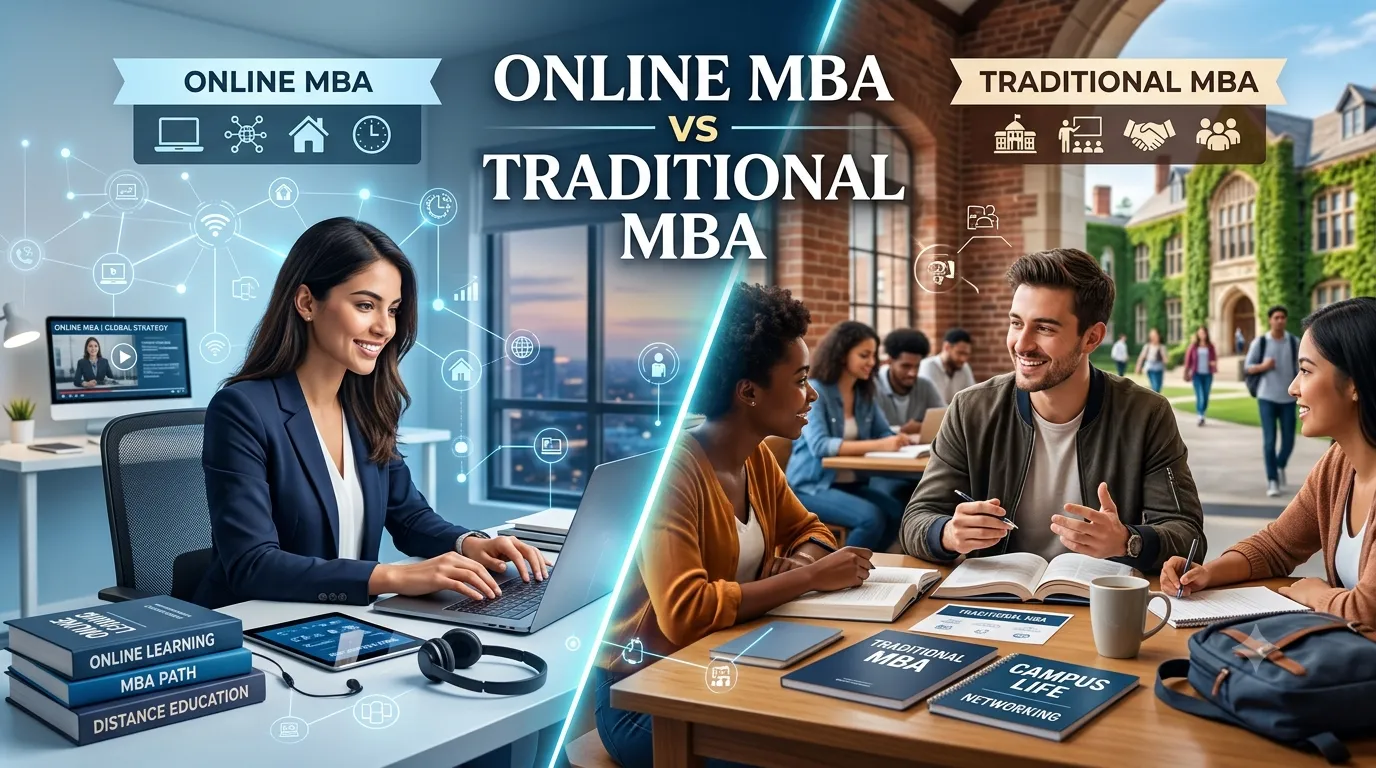
Online MBA vs Traditional MBA: Why Online Wins in 2026
Read Time:6 Minute, 1 Second
For decades, the traditional campus MBA was the only MBA worth talking about. Two years, a top college, a residential program, a placement cell. That was the formula.
In 2026, that formula has competition. And for a growing number of working professionals in India, the online MBA is not just a convenient alternative. It is the smarter one.
Here is an honest comparison of both routes.
What is a Traditional MBA?
A traditional MBA is a two-year full-time campus program. You attend classes in person, live on or near campus, interact with faculty and batchmates daily, and typically go through a campus placement process at the end.
The top traditional MBA programs in India, IIMs, ISB, XLRI, SPJIMR, offer exceptional education, powerful alumni networks, and strong placement records. For candidates who get into these institutions, the traditional route makes clear sense.
But the majority of MBA aspirants in India do not get into these programs. They end up at mid-tier or lower-tier campus programs where the placement record is weaker, the faculty quality is inconsistent, and the return on investment is unclear. For this group, the traditional MBA is not the clear winner it is often assumed to be.
What is an Online MBA?
An online MBA is a postgraduate management degree delivered through a virtual learning platform. Since UGC formally recognized online degrees as equivalent to regular campus degrees in 2020, an online MBA from a UGC entitled, NAAC accredited university carries the same academic validity as a campus MBA from the same institution.
Live classes, recorded lectures, online assessments, and virtual faculty interaction are the standard features of a quality online MBA today. The degree is issued by the same university, with the same academic standing, at a fraction of the cost and without the two-year career break.
Cost Comparison
This is where the difference is most stark.
A traditional campus MBA at a mid-tier private institution in India typically costs Rs. 8 to 20 lakhs over two years, excluding living expenses, travel, and opportunity cost of leaving a job.
A quality online MBA from a NAAC A++ accredited institution like JAIN Online costs significantly less, with EMI options that spread fees across the program duration. There is no relocation cost, no hostel fee, and no salary foregone for two years.
For a working professional earning Rs. 8 to 12 LPA, the opportunity cost of a two-year campus MBA often exceeds Rs. 15 to 20 lakhs when you account for lost income. That number changes the financial calculation entirely.
Flexibility
A traditional campus MBA requires your full attention and physical presence for two years. If you are working, you stop. If you have family commitments, you manage around a rigid schedule. If your employer is willing to sponsor your education, campus is sometimes viable. For most people, it is not.
An online MBA is built around your life, not the other way around. Live sessions are scheduled around work hours. Recorded lectures let you revise at any time. You continue earning while studying. You do not have to explain a two-year gap on your resume.
For working professionals who are 3 to 8 years into their careers, this flexibility is not a minor convenience. It is what makes the degree possible at all.
Curriculum and Faculty
This is where traditional MBA programs historically had a clear advantage. Not anymore.
Top online MBA programs in 2026 offer the same curriculum as their campus counterparts, delivered by the same faculty through live sessions. JAIN Online, for example, offers an online MBA from JAIN (Deemed-to-be University), a NAAC A++ accredited institution, with 19 specializations, live interactive faculty sessions, and 52+ AI and business tools integrated into the curriculum. If you think choosing an online MBA is best option for your situation, the curriculum depth at top accredited institutions is now comparable to what campus programs offer at the same institutional tier.
The caveat is that the quality difference is real when comparing a NAAC A++ online program against a mid-tier campus program. The online program from the better institution often delivers stronger academic content than the campus program from a weaker one.
Networking and Peer Learning
This is the one area where traditional campus MBAs still hold a genuine edge.
Two years of daily in-person interaction with batchmates builds relationships differently than virtual cohorts. The informal conversations, group projects, social events, and shared residential experience create bonds that are hard to replicate online.
That said, the network advantage of a campus MBA is concentrated at the top institutions. At a mid-tier campus program, the peer network is valuable but not dramatically better than what a structured online program with an active alumni community offers.
For candidates who cannot access the top campus programs, the networking argument for a traditional MBA is weaker than it appears.
Employer Perception
Employer perception of online MBAs has changed significantly since UGC formalized the equivalence in 2020. Large private sector employers, tech companies, startups, and BFSI firms across India now hire and promote candidates with online MBAs from accredited universities without the hesitation that existed even three years ago.
The remaining perception gap exists primarily at elite firms and top consulting and banking firms that specifically recruit from IIM and ISB placements. For every other employer category, the online MBA from a NAAC A++ institution is evaluated on its own merits.
Who Should Still Choose Traditional MBA?
Be honest about this.
If you have a genuine shot at an IIM, ISB, XLRI, or equivalent top institution, the traditional campus route is worth the cost and the career break. The placement cell, the brand, the peer cohort, and the alumni network at these institutions are genuinely superior.
If your employer is sponsoring your MBA and you have the flexibility to take two years off, campus is a reasonable choice.
If you are early in your career with no significant work experience and can fund a campus program without distress, a full-time campus experience at a strong institution builds soft skills and networks that matter.
Who Should Choose Online MBA?
The online MBA wins clearly for working professionals who are established in their careers and need the degree without stopping work.
It wins for candidates who cannot access top campus programs and would otherwise settle for a mid-tier campus MBA with unclear placement outcomes.
It wins for students in Tier 2 and Tier 3 cities who want a degree from a NAAC A++ institution without relocating.
It wins for anyone for whom the financial cost and opportunity cost of a traditional campus program make the ROI questionable.
The Verdict
In 2026, the online MBA has earned its place as a serious alternative to the traditional campus route. For most working professionals in India, it is not a compromise. It is the smarter financial and career decision.
The traditional MBA still wins at the top tier. But the top tier is a small fraction of the market. For everyone else, the online MBA from a credible, accredited institution delivers comparable education, significant cost savings, and the flexibility to keep building a career while earning the degree.

Happy
0 %

Sad
0 %

Excited
0 %

Sleepy
0 %

Angry
0 %

Surprise
0 %
 0
0
 0
0
More Stories

Top Online Degrees for Working Professionals in India
Choosing among the many online degrees for working professionals in India usually comes down to three questions: which program is...

Peptide University – Online Peptide Education & Training
Introduction The field of peptide science is expanding rapidly, creating new opportunities for researchers, healthcare professionals, students, and biotechnology enthusiasts....

The Educational Importance of IT Certification in the Modern Technology Industry
Introduction Technology continues to transform the way people live, communicate, work, and learn. From cloud computing and cybersecurity to artificial...

The Educational Value of Adobe Exams in Developing Creative Technology Skills
Introduction Digital creativity has become an essential part of today's professional world. Businesses, educational institutions, marketing agencies, publishers, and media...

Understanding the Educational Importance of AI-900 in Artificial Intelligence Fundamentals
Introduction Artificial intelligence (AI) has rapidly become one of the most transformative technologies of the modern era. From personalized recommendations...

Understanding SC-300 Learning Resources and Ethical Preparation for Identity Administration
Introduction Identity and access management have become essential components of modern cybersecurity. As organizations continue adopting cloud services and hybrid...